
Description
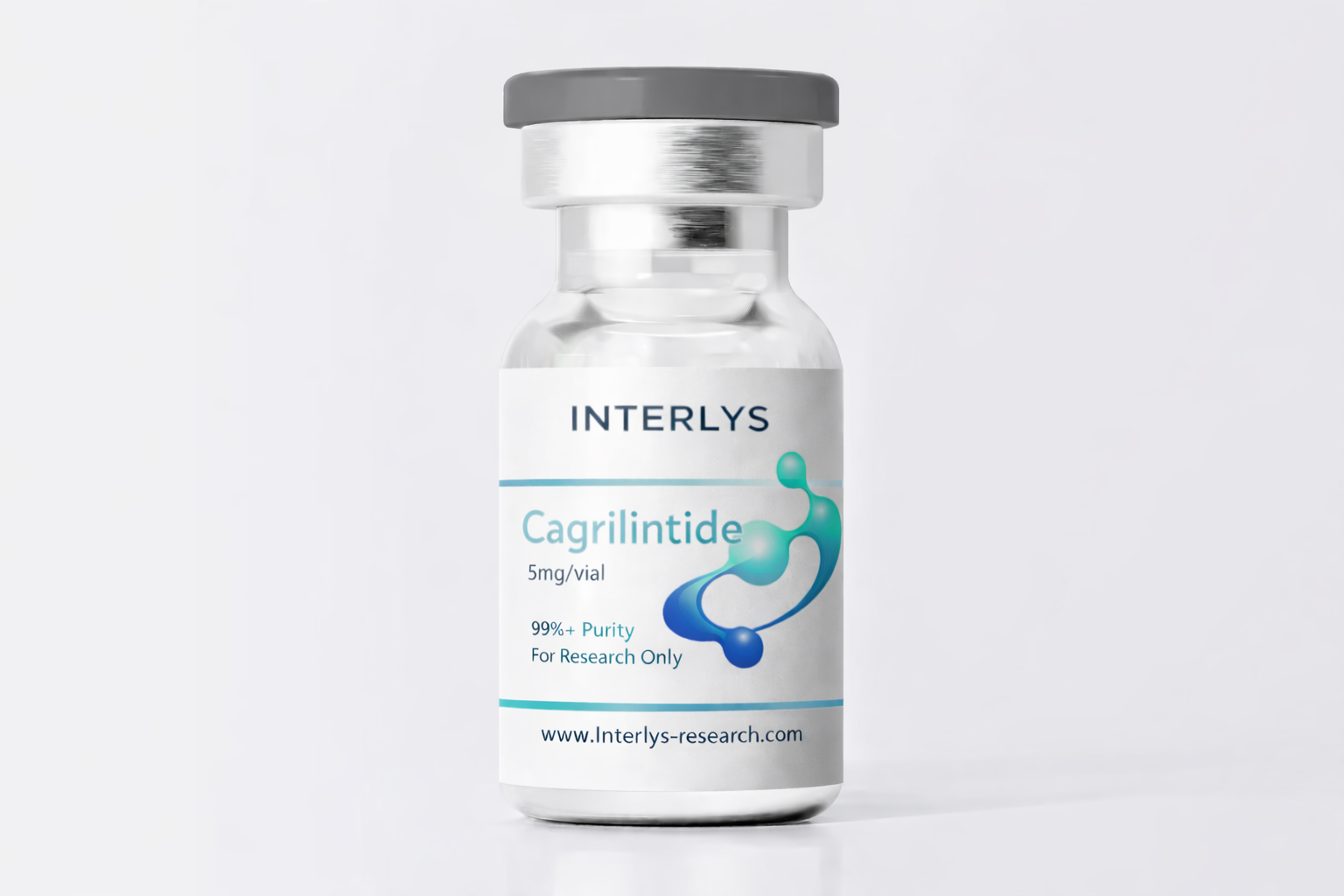
Cagrilintide is a long-acting, synthetic peptide developed for weight management and metabolic research. It is often described as a dual amylin and calcitonin receptor agonist (DACRA), designed to mimic/amplify amylin-like signaling involved in appetite regulation and energy balance. It has been studied both alone and in combination with semaglutide in clinical trials for obesity.
Molecular Formula: C₁₉₄H₃₁₂N₅₄O₅₉S₂
Molecular Weight: ~4145.8 g/mol
CAS Number: 1415456-99-3
What Are the Effects of Cagrilintide?
Cagrilintide is recognized for several key effects:
-
Weight Reduction: Clinical trials in people with overweight/obesity showed dose-related reductions in body weight compared with placebo.
-
Appetite / Food Intake Reduction: Amylin-pathway agonism is associated with reduced appetite and altered satiety signaling.
-
Potential Synergy with GLP-1 Therapy: Studies have evaluated it in combination with semaglutide, aiming for larger weight-loss effects than either pathway alone.
How Does It Work?
Cagrilintide targets calcitonin-family receptors involved in amylin biology (amylin receptors are formed by the calcitonin receptor combined with RAMP proteins). By activating these receptor complexes, cagrilintide supports satiety signaling and appetite regulation. Recent structural and mechanistic work highlights an amylin-like binding mode with distinct receptor dynamics that may contribute to its clinical profile.
Scientific Evidence and Research Status
Cagrilintide has been tested in human clinical trials for weight management, including phase 2 studies using multiple dose levels (as monotherapy and in combination with semaglutide). Results showed meaningful weight-loss effects across studied doses, but it remains part of an evolving evidence base, with ongoing research to refine long-term outcomes, safety, and optimal positioning in obesity treatment.
Role in Sports and Performance Contexts
In physique/performance circles, cagrilintide can be discussed mainly for its appetite suppression and weight-loss effects. However, use outside clinical supervision raises health risks (side effects, nutrition issues, product quality, etc.).
Regarding anti-doping: the WADA Prohibited List is updated annually, and substances may be prohibited by class/category even if not named individually. Athletes should verify status via official anti-doping resources and medical staff.
Standard Dosage
Initiate with 0.3 mg subcutaneously once weekly for 4 weeks to build tolerance. Increase to 0.6 mg weekly in weeks 5-8, then 1.2 mg in weeks 9-12, administered any time of day with site rotation.
Escalate to 2.4 mg weekly by week 17 (after 1.8 mg in weeks 13-16), maintained long-term for obesity research. Combine with diet for enhanced fat loss effects.
These values reflect published trial dose levels and do not represent a one-size-fits-all recommendation.
Storage Instructions
Once the peptides are reconstituted (mixed with bacteriostatic water), they must be stored in the fridge to maintain stability. After reconstitution, the peptides will remain stable for up to 30 days.
Lyophilization is a unique dehydration process, also known as cryodesiccation, where the peptides are frozen and then subjected to low pressure. This causes the water in the peptide vial to sublimate directly from solid to gas, leaving behind a stable, crystalline white structure known as lyophilized peptide. The puffy white powder can be stored at room temperature until you’re ready to reconstitute it with bacteriostatic water.
Once peptides have been received, it is imperative that they are kept cold and away from light. If the peptides will be used immediately, or in the next several days, weeks or months, short-term refrigeration under 4℃ (39℉) is generally acceptable. Lyophilized peptides are usually stable at room temperatures for several weeks or more, so if they will be utilized within weeks or months such storage is typically adequate.However, for longer term storage (several months to years) it is more preferable to store peptides in a freezer at -80℃ (-112℉). When storing peptides for months or even years, freezing is optimal in order to preserve the peptide’s stability.
Reviews
There are no reviews yet.