
Description
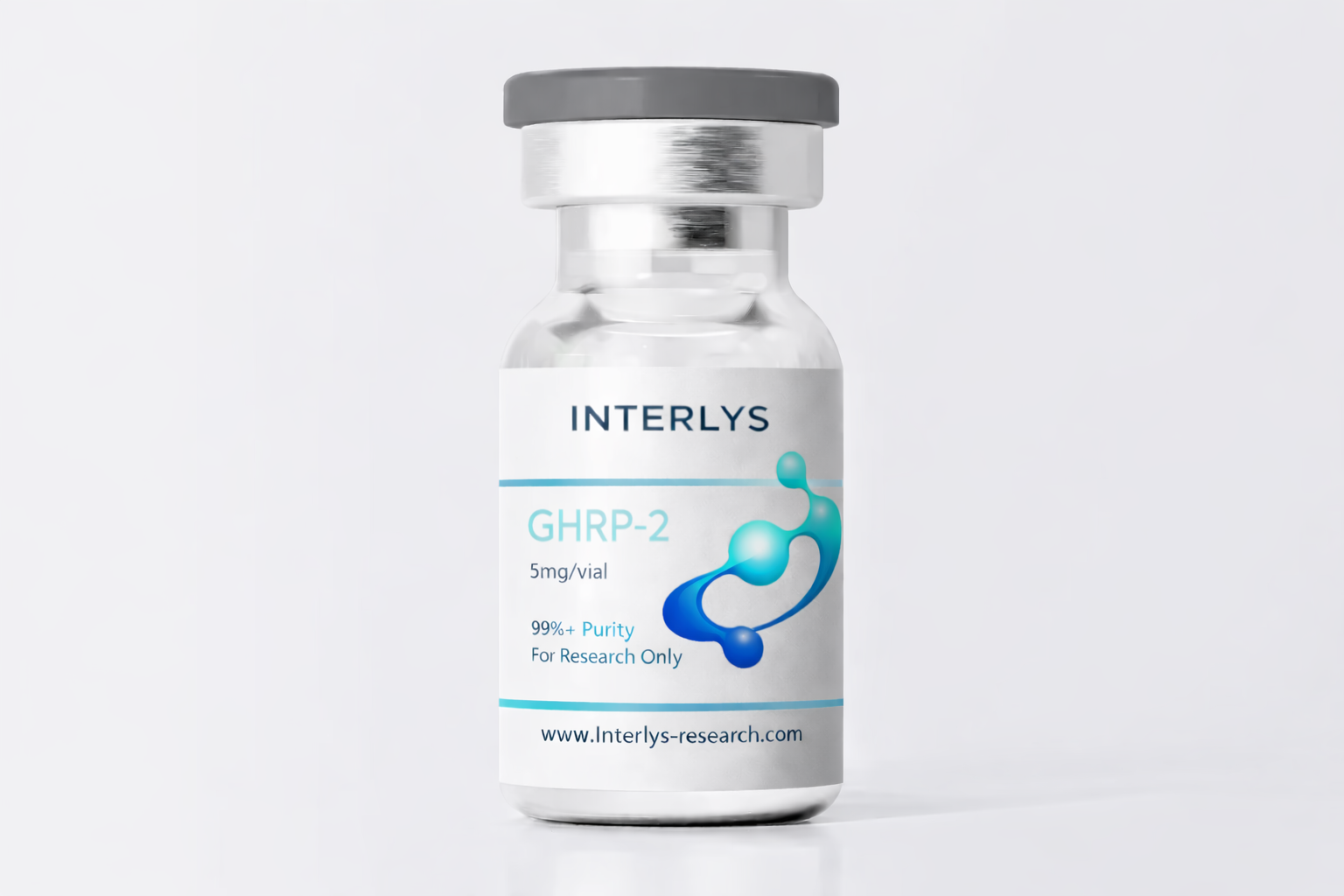
GHRP-2, scientifically known as Growth Hormone Releasing Peptide-2, is a synthetic peptide classified as a growth hormone secretagogue. It was developed in research settings to stimulate the endogenous release of growth hormone (GH) by acting on the growth hormone secretagogue receptor (GHS-R1a), also known as the ghrelin receptor. Unlike exogenous growth hormone, GHRP-2 does not supply GH directly but promotes its natural pulsatile secretion.
Molecular Formula: C₄₅H₅₅N₉O₆
Molecular Weight: ~817.97 g/mol
CAS Number: 158861-67-7
What Are the Effects of GHRP-2?
GHRP-2 is associated with several key effects:
-
Stimulation of Growth Hormone Secretion: Triggers GH release from the pituitary gland in a dose-dependent manner.
-
Indirect Increase in IGF-1: Elevated GH levels may lead to increased hepatic IGF-1 production.
-
Appetite Stimulation: Activation of the ghrelin receptor can increase hunger and food intake.
-
Interest in Recovery and Body Composition: Increased GH signaling has been linked to tissue repair processes and metabolic effects, though outcomes vary widely.
How Does It Work?
GHRP-2 acts primarily by binding to the GHS-R1a (ghrelin) receptor, which stimulates intracellular signaling pathways that lead to pulsatile growth hormone release from the anterior pituitary. This mechanism is distinct from, but complementary to, the growth hormone–releasing hormone (GHRH) pathway.
Because GH secretion is naturally pulsatile and influenced by factors such as sleep, nutrition, stress, and age, the response to GHRP-2 can differ significantly between individuals.
Scientific Evidence and Research Status
GHRP-2 has been studied in both experimental and limited clinical research contexts to evaluate its ability to stimulate GH secretion and assess endocrine responsiveness. While its pharmacological effect on GH release is well documented, there is no broad clinical consensus regarding its long-term therapeutic application outside controlled medical or research environments. Its safety profile, especially with repeated exposure, remains an area requiring further study.
Role in Sports and Performance Contexts
GHRP-2 has attracted attention in athletic and physique-oriented environments due to its effects on the GH/IGF-1 axis. However, such use is non-medical and not supported by strong evidence demonstrating safe or ethical performance enhancement.
The World Anti-Doping Agency (WADA) classifies growth hormone–releasing factors and secretagogues as prohibited substances, as they can alter hormonal balance and potentially confer an unfair advantage in recovery and body composition.
Standard Dosage
Administer 150-200 mcg per dose, 2-3 times daily (morning, post-workout, bedtime), totaling 300-600 mcg daily. Cycles run 8-12 weeks followed by 4 weeks off.
Storage Instructions
Once the peptides are reconstituted (mixed with bacteriostatic water), they must be stored in the fridge to maintain stability. After reconstitution, the peptides will remain stable for up to 30 days.
Lyophilization is a unique dehydration process, also known as cryodesiccation, where the peptides are frozen and then subjected to low pressure. This causes the water in the peptide vial to sublimate directly from solid to gas, leaving behind a stable, crystalline white structure known as lyophilized peptide. The puffy white powder can be stored at room temperature until you’re ready to reconstitute it with bacteriostatic water.
Once peptides have been received, it is imperative that they are kept cold and away from light. If the peptides will be used immediately, or in the next several days, weeks or months, short-term refrigeration under 4℃ (39℉) is generally acceptable. Lyophilized peptides are usually stable at room temperatures for several weeks or more, so if they will be utilized within weeks or months such storage is typically adequate.However, for longer term storage (several months to years) it is more preferable to store peptides in a freezer at -80℃ (-112℉). When storing peptides for months or even years, freezing is optimal in order to preserve the peptide’s stability.
Reviews
There are no reviews yet.