
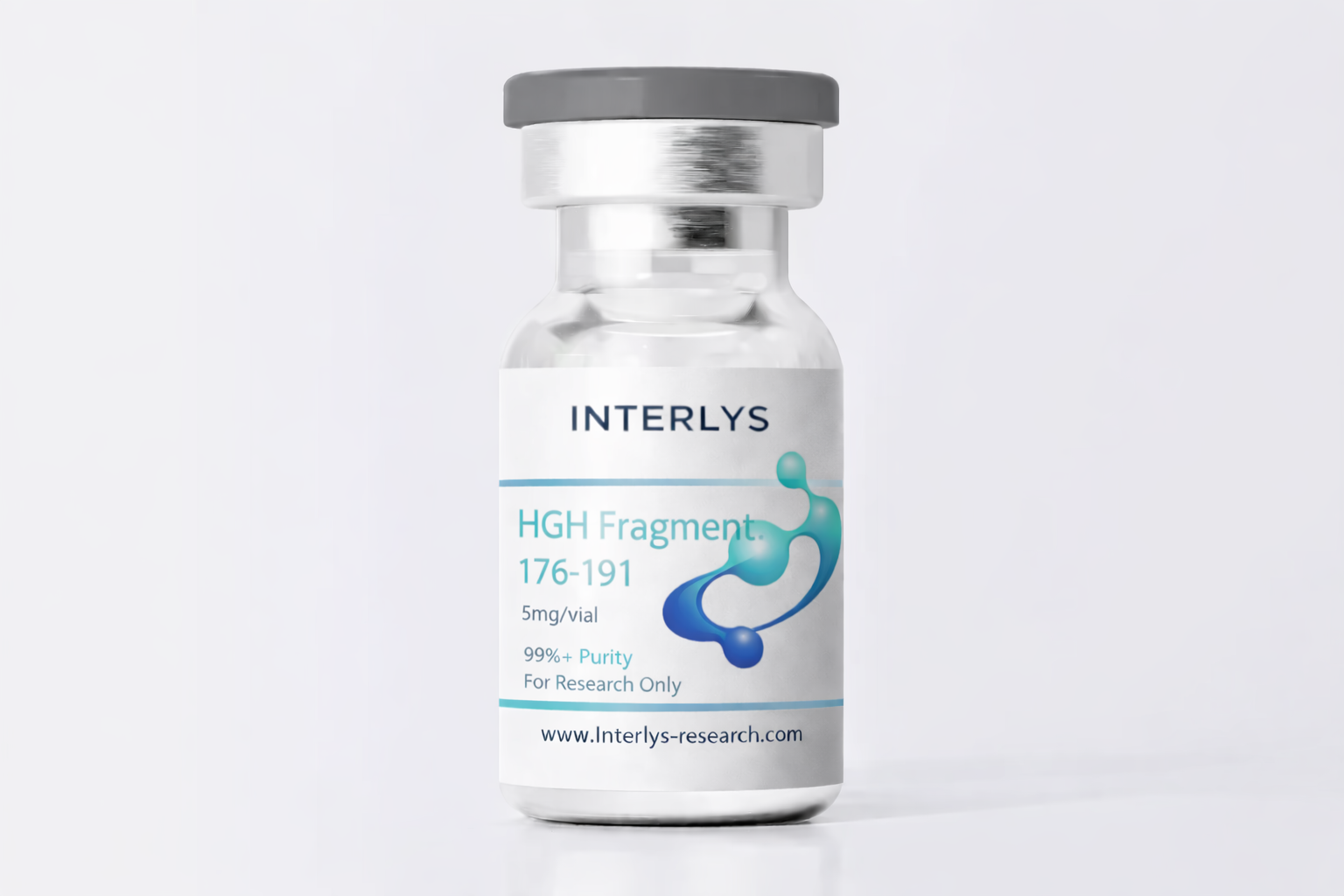
Description
HGH Fragment 176–191 (also written hGH 176–191) is a 16–amino-acid fragment taken from the C-terminal region of human growth hormone. It was explored in research because early work suggested this region could retain lipolytic (“fat-metabolism”) activity with fewer classic “growth” effects than full-length HGH. A closely related modified analogue often discussed in the literature is AOD9604 (a variant of the same C-terminal region).
Molecular Formula: C₇₈H₁₂₅N₂₃O₂₃S₂
Molecular Weight: ~1817.12 g/mol
CAS Number: 66004-57-7
What Are the Effects of HGH Fragment 176–191?
HGH Fragment 176–191 is mainly discussed for these research-linked functions:
-
Increased fat oxidation / lipolysis (preclinical): Studies in obese mouse models reported changes consistent with increased fat oxidation and lipolysis after chronic treatment with the lipolytic fragment (AOD9604).
-
Body weight and fat-mass reduction in obese models: Long-term administration in obese mice reduced body weight gain/body fat compared with controls in certain experiments.
-
Lower “growth-like” activity than full HGH (concept): The fragment/analogue is often described as not acting like full HGH on growth pathways (e.g., less receptor competition / less proliferative signaling in some reports).
How Does It Work?
Mechanistic research suggests the lipolytic fragment’s effects may involve adipose-tissue pathways and interaction with β-adrenergic signaling, particularly the β3-adrenergic receptor (β3-AR) in fat cells. In one study, chronic treatment in obese mice increased β3-AR expression and the expected metabolic effects were reduced in β3-AR knockout mice, supporting a β3-AR-linked mechanism.
Scientific Evidence and Research Status
Most of the strong evidence around hGH 176–191 comes from animal studies and from clinical development of its analogue AOD9604. Human data for the exact fragment (176–191) is limited compared with approved anti-obesity medications, and some clinical development programs for AOD9604 did not ultimately establish strong commercial/clinical utility as an obesity drug.
Role in Sports and Performance Contexts
In physique and “fat loss” circles, HGH Fragment 176–191 is discussed for targeted fat-metabolism effects. However, it is explicitly addressed in anti-doping rules:
The WADA Prohibited List includes growth hormone (GH), its analogues and fragments, explicitly giving examples such as AOD-9604 and hGH 176–191.
Standard Dosage
Use 250-500 mcg per day, divided into two doses (e.g., 250 mcg AM and PM) for enhanced fat-burning effects. Cycles last 8-12 weeks followed by a 4-week break.
These figures reflect research and trial dose levels (mostly for AOD9604 rather than the unmodified fragment) and do not establish a standardized medical dose for general use.
Storage Instructions
Once the peptides are reconstituted (mixed with bacteriostatic water), they must be stored in the fridge to maintain stability. After reconstitution, the peptides will remain stable for up to 30 days.
Lyophilization is a unique dehydration process, also known as cryodesiccation, where the peptides are frozen and then subjected to low pressure. This causes the water in the peptide vial to sublimate directly from solid to gas, leaving behind a stable, crystalline white structure known as lyophilized peptide. The puffy white powder can be stored at room temperature until you’re ready to reconstitute it with bacteriostatic water.
Once peptides have been received, it is imperative that they are kept cold and away from light. If the peptides will be used immediately, or in the next several days, weeks or months, short-term refrigeration under 4℃ (39℉) is generally acceptable. Lyophilized peptides are usually stable at room temperatures for several weeks or more, so if they will be utilized within weeks or months such storage is typically adequate.However, for longer term storage (several months to years) it is more preferable to store peptides in a freezer at -80℃ (-112℉). When storing peptides for months or even years, freezing is optimal in order to preserve the peptide’s stability.
Reviews
There are no reviews yet.