
Description
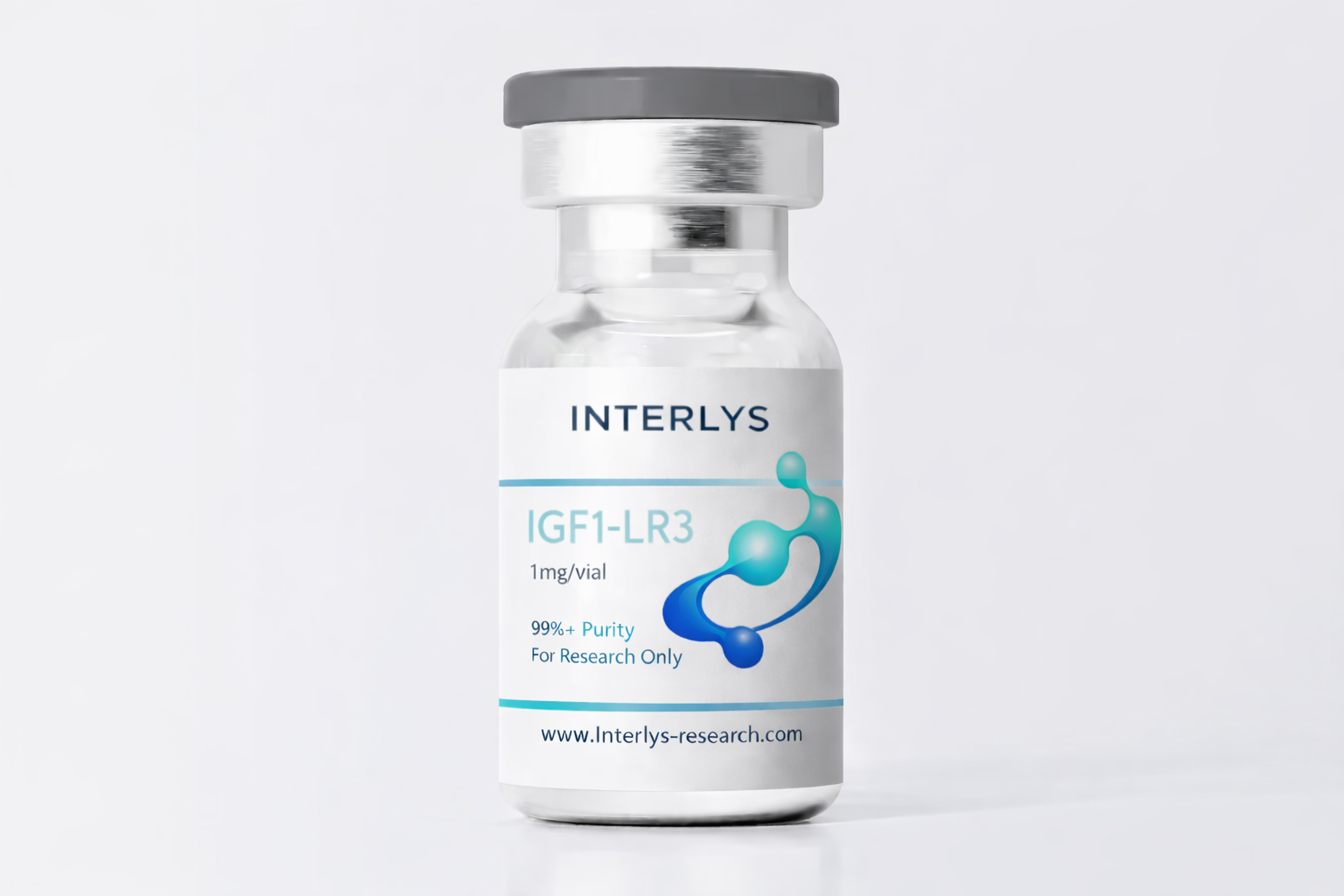
IGF-1 LR3 (Long R3 IGF-1) is a synthetic analogue of human insulin-like growth factor-1 (IGF-1). It was engineered to have reduced binding to IGF-binding proteins (IGFBPs) and improved stability compared with native IGF-1. Structurally, it contains the full IGF-1 sequence with an arginine substitution at position 3 and an additional 13-amino-acid N-terminal extension, for a total of 83 amino acids.
Molecular Formula: C₄₀₀H₆₂₅N₁₁₁O₁₁₅S₉
Molecular Weight: ~9117.6 g/mol
CAS Number: 946870-92-4 (commonly listed for IGF-1 LR3 in reagent catalogs)
What Are the Effects of IGF-1 LR3?
IGF-1 LR3 is recognized for several key biological actions (based on IGF-1 receptor signaling and experimental use):
-
Cell Growth and Proliferation: IGF signaling is strongly associated with mitogenic and anabolic cellular effects.
-
Tissue Repair / Regeneration Interest: IGF-1 is widely studied in repair contexts (e.g., nerve/tendon models), and LR3 variants are used experimentally because of altered IGFBP interactions.
-
Higher “Bioavailability” in Cell Culture: Because LR3 binds poorly to IGFBPs, it can show stronger effects in vitro compared with IGF-1 under certain conditions.
How Does It Work?
IGF-1 LR3 works primarily as an agonist of the IGF-1 receptor (IGF-1R). Activation of IGF-1R triggers intracellular signaling cascades (notably PI3K/AKT and MAPK/ERK pathways) involved in cell survival, proliferation, and metabolism.
A key engineered feature is its very low affinity for IGF-binding proteins (IGFBPs), which normally bind IGF-1 in circulation and regulate its availability. By reducing IGFBP binding, IGF-1 LR3 can remain more “free” in experimental systems, which is why it is popular in cell culture and mechanistic research.
Scientific Evidence and Research Status
IGF-1 (as a biological pathway) is well established in human physiology, and therapeutic IGF-1 exists for specific medical indications. However, IGF-1 LR3 specifically is mainly used as a research reagent (especially in cell culture and experimental models), and its clinical safety/efficacy framework as a distinct therapeutic is not established in routine medicine.
Role in Sports and Performance Contexts
In bodybuilding/athletic circles, IGF-1 LR3 is discussed for potential “anabolic” and recovery-related effects because IGF signaling is linked to growth pathways. However, this is controversial and medically risky when used outside controlled settings.
Importantly, IGF-1 and its analogues are on the WADA Prohibited List under peptide hormones/growth factors categories.
Standard Dosage
Inject 40-80 mcg daily (or split into two 20-40 mcg doses AM/post-workout)
Because IGF-1 LR3 is primarily a research reagent, there is no standardized clinical dosage for general use, and translating in-vitro concentrations to human dosing is not scientifically direct or safe.
Storage Instructions
Once the peptides are reconstituted (mixed with bacteriostatic water), they must be stored in the fridge to maintain stability. After reconstitution, the peptides will remain stable for up to 30 days.
Lyophilization is a unique dehydration process, also known as cryodesiccation, where the peptides are frozen and then subjected to low pressure. This causes the water in the peptide vial to sublimate directly from solid to gas, leaving behind a stable, crystalline white structure known as lyophilized peptide. The puffy white powder can be stored at room temperature until you’re ready to reconstitute it with bacteriostatic water.
Once peptides have been received, it is imperative that they are kept cold and away from light. If the peptides will be used immediately, or in the next several days, weeks or months, short-term refrigeration under 4℃ (39℉) is generally acceptable. Lyophilized peptides are usually stable at room temperatures for several weeks or more, so if they will be utilized within weeks or months such storage is typically adequate.However, for longer term storage (several months to years) it is more preferable to store peptides in a freezer at -80℃ (-112℉). When storing peptides for months or even years, freezing is optimal in order to preserve the peptide’s stability.
Reviews
There are no reviews yet.