
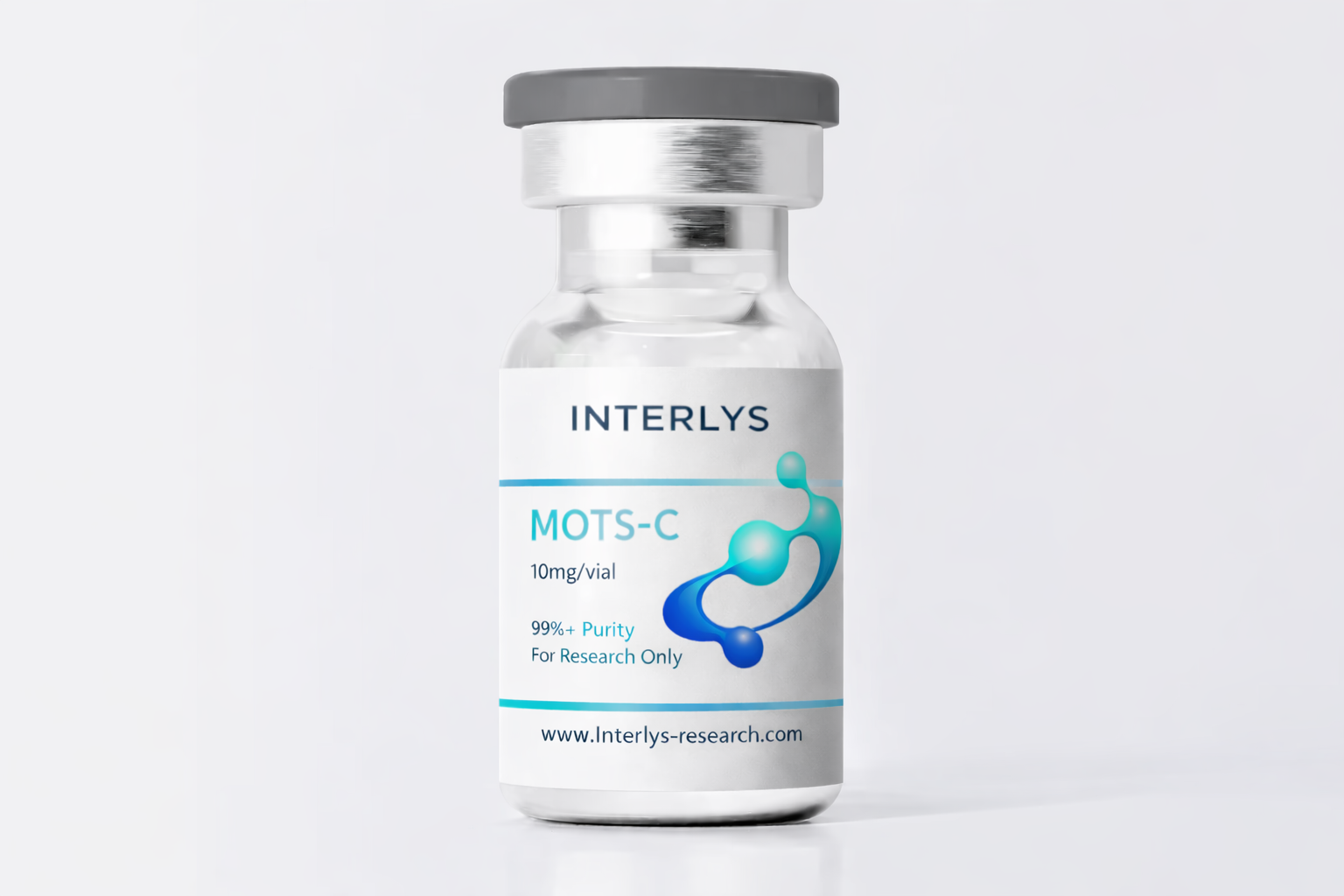
Description
MOTS-c is a mitochondrial-derived peptide naturally encoded by mitochondrial DNA. It is a short peptide (16 amino acids) produced from a small open reading frame within the mitochondrial 12S rRNA region. MOTS-c has attracted attention for its potential role in metabolic regulation, particularly insulin sensitivity and cellular energy balance.
Molecular Formula: C101H152N28O22S2
Molecular Weight: ~2174.6 g/mol
CAS Number: 1627580-64-6
What Are the Effects of MOTS-c?
MOTS-c is recognized for several key functions:
-
Improved Insulin Sensitivity: Research suggests MOTS-c may enhance insulin responsiveness and glucose handling.
-
Metabolic Regulation: It is associated with improved metabolic homeostasis and energy balance.
-
Exercise / Physical Capacity Interest: Some studies link MOTS-c to exercise-related metabolic adaptation and physical performance in animal models.
-
Cellular Stress Response: MOTS-c is studied for signaling roles related to cellular resilience under metabolic stress.
How Does It Work?
MOTS-c appears to influence metabolism by interacting with pathways linked to cellular energy status. Mechanistic research indicates that MOTS-c can affect the folate cycle and de novo purine biosynthesis, leading to activation of AMPK (AMP-activated protein kinase), a central regulator of energy homeostasis. Through these effects, MOTS-c may promote improved glucose control and metabolic flexibility, especially in skeletal muscle.
Scientific Evidence and Research Status
MOTS-c has strong interest in preclinical research, with studies showing beneficial effects on obesity-related metabolic outcomes in mouse models (e.g., high-fat diet contexts). However, robust human clinical evidence remains limited, meaning its long-term safety, optimal dosing parameters, and real-world efficacy in humans are not fully established.
Role in Sports and Performance Contexts
MOTS-c has circulated in performance and physique communities due to its association with metabolic function and “exercise-like” signaling. However, it remains an experimental peptide, and athletes should be cautious: anti-doping organizations have warned that MOTS-c is a prohibited experimental peptide and carries health and integrity risks when used outside legitimate medical research.
Standard Dosage
Increase to 400-800 mcg daily (weeks 3-8), then maintain 1 mg (1,000 mcg) daily for weeks 9-12. Cycle 8-16 weeks followed by 4-8 weeks off.
Importantly, these values come from preclinical research and do not establish a standardized human dosage. Human dosing guidance is not universally defined, and further clinical data is needed to determine safe and effective parameters.
Storage Instructions
Once the peptides are reconstituted (mixed with bacteriostatic water), they must be stored in the fridge to maintain stability. After reconstitution, the peptides will remain stable for up to 30 days.
Lyophilization is a unique dehydration process, also known as cryodesiccation, where the peptides are frozen and then subjected to low pressure. This causes the water in the peptide vial to sublimate directly from solid to gas, leaving behind a stable, crystalline white structure known as lyophilized peptide. The puffy white powder can be stored at room temperature until you’re ready to reconstitute it with bacteriostatic water.
Once peptides have been received, it is imperative that they are kept cold and away from light. If the peptides will be used immediately, or in the next several days, weeks or months, short-term refrigeration under 4℃ (39℉) is generally acceptable. Lyophilized peptides are usually stable at room temperatures for several weeks or more, so if they will be utilized within weeks or months such storage is typically adequate.However, for longer term storage (several months to years) it is more preferable to store peptides in a freezer at -80℃ (-112℉). When storing peptides for months or even years, freezing is optimal in order to preserve the peptide’s stability.






Reviews
There are no reviews yet.